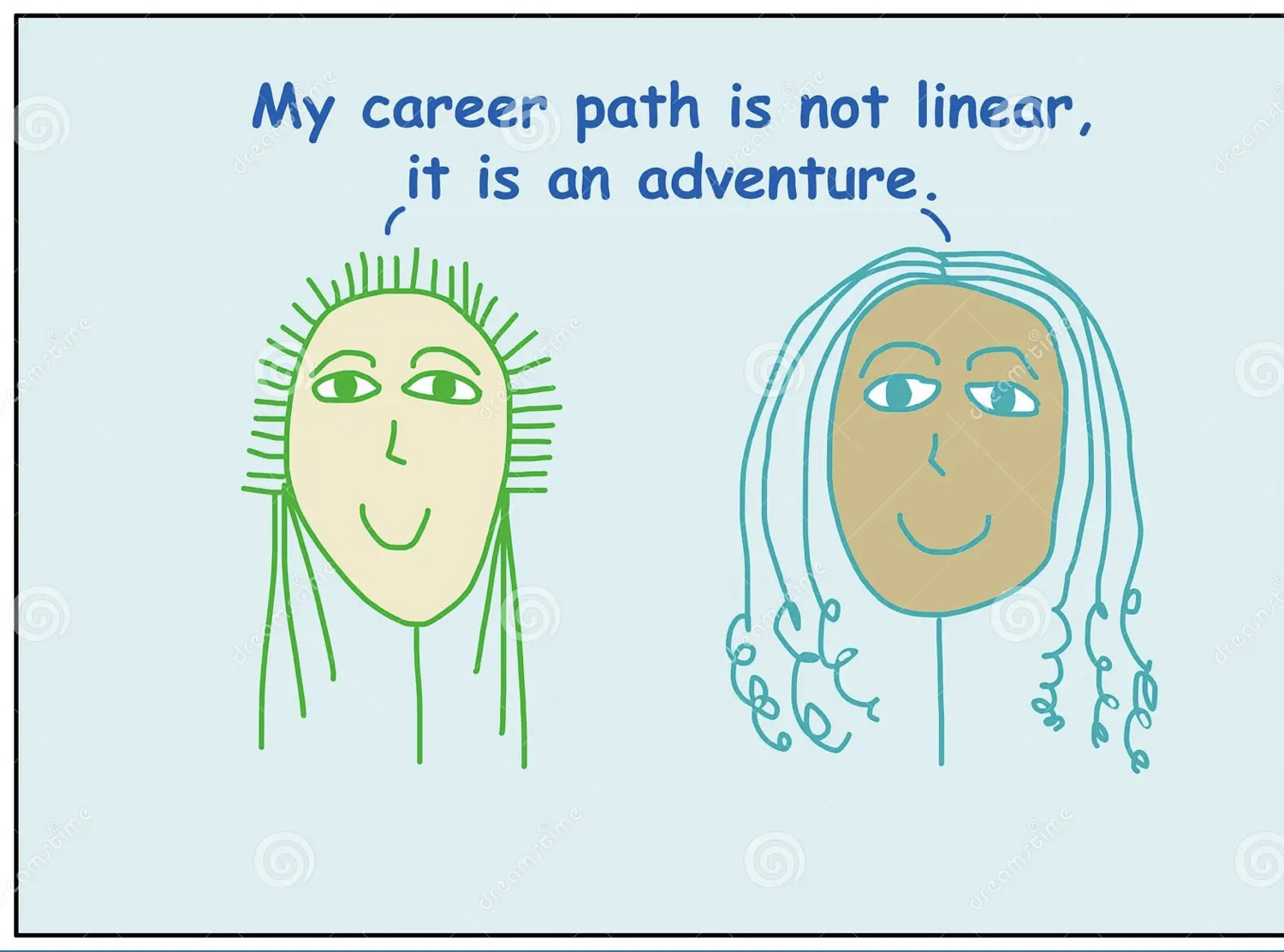
My resume does not read like a ladder. It reads like a person.
I have sold greeting cards in a carreta in Plaza Las Américas. I have run bingo for a hundred viejitos in a senior housing facility. I have knocked on the door of a stranger during a pandemic to ask how many people slept in that house.
I have also worked at Leo Burnett.
All of that is the same career. Mine.
For years there was one part of it I did not want anybody to ask about. Between Sobremesa Chicago and Leo Burnett there is a space, and in that space I was babysitting, dog sitting, and working as a field agent for the 2020 Census.
Real work. All of it. But when somebody asked me “so what were you doing in 2020,” my voice got small. I gave a short answer and changed the subject fast, like I was hiding something.
I was not hiding anything. I was surviving a year that broke the entire world. But somewhere in my head lived this idea that a resume is supposed to be a clean line, and mine had a baby and a dog in it.
The jobs nobody puts on LinkedIn
Since we are here, let me give you the full list. The ones that never made it to the pretty version.
My first job in Chicago was activity coordinator at a senior housing facility. Bingo, birthdays, movie afternoons, and a hundred residents who had opinions about all of it.
In 2018 I was the social media manager for Ruido Fest, a music festival in Chicago.
That same year, on my Christmas vacation in Puerto Rico, I worked in una carreta de Bien Cool in Plaza Las Américas, selling greeting cards. The kind people still buy to send in the mail. On my vacation. In a kiosk. Selling.
That same Christmas, I also helped build the social media strategy for a coworking space in Puerto Rico.
At one point I was the caregiver for an 80 year old man, and I am going to say something that will sound dramatic but is true: those were some of the best conversations I have ever had in my life. Better than most meetings I have sat in since.
And then 2020. The babies, the dogs, and the Census.
None of that fits on a resume. All of that is why I am good at what I do.
What those jobs actually taught me
The carreta taught me how to sell something to a person who is walking fast and does not want to stop. That is the entire job of marketing, by the way. Everybody dresses it up with fancy words, but that is the job.
The festival taught me how to speak to a bilingual audience without translating, because translating and speaking are not the same thing. One sounds like a robot. The other sounds like home.
The senior housing facility taught me how to plan an event for people who will tell you exactly what they think of it, out loud, while it is still happening. There is no focus group in the world more honest than a room of viejitos on a Tuesday.
The 80 year old man taught me how to listen without waiting for my turn to talk.
The Census taught me how to knock on a door where nobody wants to see me, and get the information anyway, con respeto. If you can do that, you can do stakeholder engagement in any building in this country.
The babies and the dogs taught me that a paycheck is a paycheck and my dignity was never in danger.
So when a recruiter looks at my resume and sees a jump, I need you to know what a jump actually is. It is not a person who could not commit. It is a person who kept the lights on, kept learning, and kept moving.
The part I will argue with anybody about
Here is my opinion, and I am not soft about it.
Careers do not have to be linear. The only exceptions I accept are the ones where the line exists for a real reason: doctors, scientists, pilots, the people whose training builds on itself for years because a mistake costs a life. Fine. Stay in the line. I want my surgeon to have a very boring resume.
But the rest of us? The office jobs, the strategy jobs, the program jobs, the marketing jobs? The line is decoration. Nobody is safer because I stayed at one company for nine years. Nobody is better served because my titles went up one step at a time in a nice little order.
And while I am here: most of those jobs can be done remote, and everybody in a corner office knows it. We proved it. We all proved it together in 2020, and then a lot of people decided to forget on purpose.
I am not the only one saying this
Amy Weaver, the CEO of Direct Relief, told Forbes she would tell her younger self to Forbes Article, and that not one of her most pivotal career moments came from an obvious promotion.
And Alexa Rose wrote something in her newsletter that I keep repeating to myself: if your career looks messy, Why a Non-Linear Career Might Be Your Biggest Advantage in 2026it means your leverage is still forming.
Leverage. Not damage. Leverage.
For the recruiter reading this
I know you are out there. I know somebody opens these blogs from a laptop with fourteen tabs of candidates.
So let me save you the guessing.
Yes, my path moves. Yes, I have worked in a kiosk and in an agency in the same decade. Yes, there is a year in there where I watched other people’s kids and dogs and counted people for the government.
What you are looking at is not instability. It is range. It is someone who has been in the room with a festival crowd, a small business owner, a corporate client, a viejito who just wanted company, and a stranger who did not want to open the door.
I am hard to summarize in eleven seconds. That is the only real problem with my resume, and it is not mine to fix.
If your own career does not fit in a straight line either, good. That is the whole point of this blog. And if you want to see how my zigzag actually reads when I stop apologizing for it, my CV is right here on this site.
Thank you for reading me,
Génesis 🍒