

I was a happy Puerto Rican — until I moved to Chicago. There, I became a proud, patriotic Puerto Rican.
There’s a difference. A big one. And it took me leaving to understand it.
Summer 2014. My second time visiting Chicago. I’m with my mom, tía, and tío; in Pilsen, a Mexican neighborhood on the southwest side. And there they are.
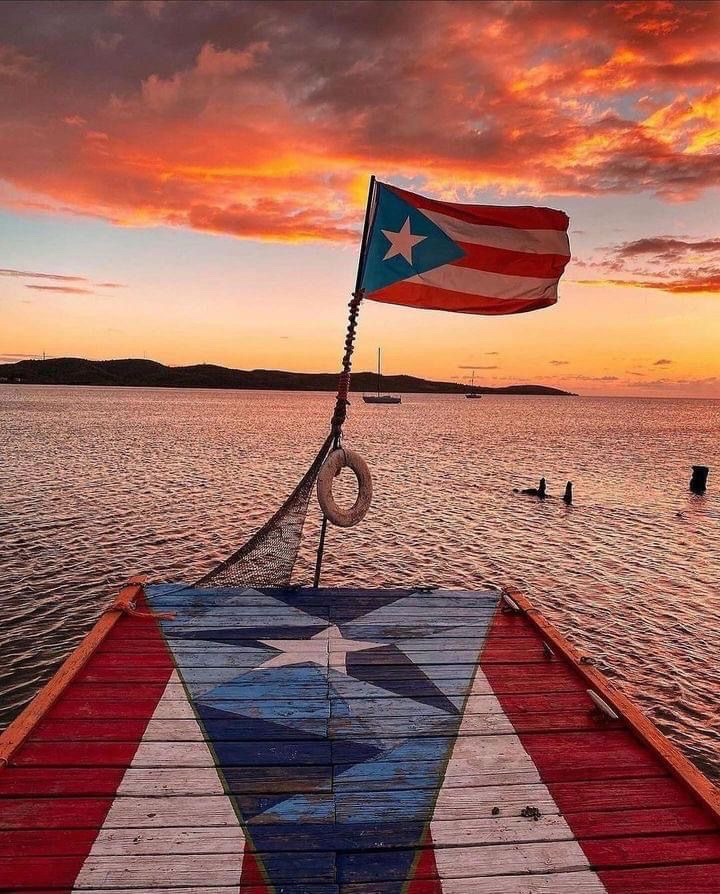
Puerto Rican flags. Everywhere.
My first thought, I swear, was just: “Que cool, banderas de PR, con el azul que es.”
That was it. That was the whole reaction. Happy. Innocent. Not yet anything deeper than that. I just thought it was cool that someone put up our flag in this Mexican neighborhood. I noticed the blue — the specific blue, azul clarito, the original — and I smiled and kept walking.
I had no idea what I was looking at.
Growing up in Puerto Rico, I was lucky. My high school history teacher was J. Costa — and because of her, I knew more than most. She’s the reason I learned to be curious about history, to travel, to read critically, to question what’s not in the textbook. She taught me that Puerto Ricans were once prohibited from displaying their own flag. That it was illegal. That people went to prison for it.
I knew it. I just didn’t feel it yet.
That’s the thing about learning history in the place where it happened — it can still feel abstract. Distant. Like something that was, not something that is. Puerto Rico surrounded me so completely that I never had to think about what it meant to be Puerto Rican. It was just oxygen. You don’t think about oxygen until you’re somewhere that doesn’t have enough of it.
After I moved to Chicago, I started doing what Janina taught me — asking questions, digging deeper. And I really learned. Not the clean version. La historia de Puerto Rico que no está en los libros de historia.
The Gag Law. Law 53 of 1948. You could go to prison for owning a Puerto Rican flag. For singing a patriotic song. For speaking about independence in public. In your own country. Your own home.
And suddenly those flags in Pilsen — in a Mexican neighborhood, thousands of miles from the island — made complete sense. That community wasn’t decorating. They were remembering. They were refusing. They were saying you tried to erase this and here it is, azul clarito, on every corner, and we’re not asking permission.
I didn’t move to Chicago and find my identity. I moved to Chicago and finally understood what it cost.
That’s when happy became proud. And proud is heavier. Proud has history in it. Proud means you know what you’re carrying.
“La Patria es valor y sacrificio.” — Pedro Albizu Campos
Don Pedro didn’t say the homeland is the place you were born. He didn’t say it’s the food or the music or the flag on your wall. He said it’s courage. It’s sacrifice. It’s something you choose, actively, even when — especially when — it costs you something.
I understood that for the first time not in Puerto Rico. But on a street in a Mexican neighborhood in Chicago, on a summer afternoon, looking at a flag I’d seen my whole life and finally, truly seeing it.
Now I live between two places and I don’t know where I belong — or if belonging is even the right word anymore. Chicago gave me my pride. Puerto Rico gave me my roots. And every few months I’m on a plane asking myself the same question I still don’t have an answer to:
Where do I go?
I don’t know. What I do know is that wherever I land, I’m Puerto Rican out loud. Not because it’s easy or automatic or ambient the way it used to be — but because I know now what it means. What it cost. What it’s worth.
Azul clarito. Siempre. 🩵
Gracias por leerme 😽
Génesis🍒